PRACTICAL GUIDE

Project Thinking For Tech Teams

Not everyone needs to be a project manager. But everyone working on a project benefits from having a way to think about their work—some basic principles that help them navigate it.

There’s no shortage of information about project management—methodologies, tools, frameworks... And yet, there’s surprisingly little practical guidance that reflects the reality of day-to-day project work in a way that’s useful for the whole team.

This guide is a step towards making complex project work easier to navigate.
~90 min read   ·   Last updated: May 2026
AT A GLANCE

How the guide is structured

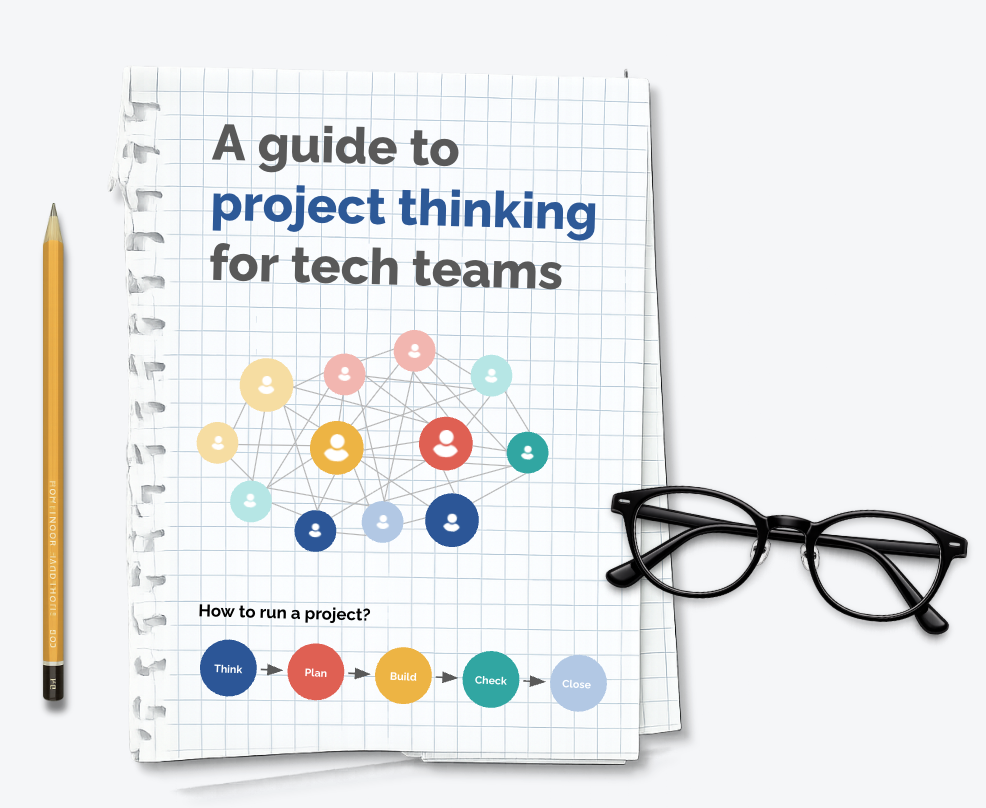
Each chapter focuses on a different aspect of project work — understanding what matters, creating a realistic plan, moving the work forward, adapting when things change, and finishing strong. Together, they form a practical mental model for navigating work that rarely goes as intended.

01
Introduction
☕ 9 min
What is project thinking?

The easiest way to understand project thinking is to watch two people approach the same work in different ways.

KEY QUESTION:
What turns a chaotic set of tasks into a meaningful project?
project thinking
clarity
mindset
02
Chapter 01
☕ 15 min
Initiating — Define Why and Set Direction

Clarifying the real problem and choosing a direction that makes sense.

KEY QUESTION:
Why are we doing this?
defining purpose
goal clarity
stakeholder understanding
problem framing
stakeholder alignment
03
Chapter 02
☕ 15 min
in progress
Planning — Move From Why to How

Turning intent into a workable plan while staying realistic about uncertainty.

KEY QUESTION:
How might we approach this?
roadmap thinking
estimation
sequencing
dependency mapping
constraints awareness
04
Chapter 03
☕ 15 min
coming soon
Executing — Turn Plan Into Action

Doing the work, adapting as you go, and keeping people aligned.

KEY QUESTION:
How do we move forward?
collaboration
iteration
focus management
problem-solving
ownership
05
Chapter 04
☕ 15 min
coming soon
Monitoring — Stay Oriented

Checking whether the work still makes sense and adjusting when needed.

KEY QUESTION:
Are we still on the right track?
progress awareness
feedback loops
reviews
course correction
transparency
06
Chapter 05
☕ 15 min
coming soon
Closing — Capture Value and Move Forward

Finishing properly and carrying learning forward.

KEY QUESTION:
What do we take from this?
lessons learned
knowledge transfer
impact evaluation
continuity
team recognition
07
Summary
☕ 5 min
coming soon
Summary — Make Your Next Project Meaningful

Connecting the ideas and seeing how they work together in practice.

KEY QUESTION:
How does this come together in real work?
project thinking
mindset
pattern recognition
adaptability
business value
BEFORE YOU START

How to use this guide

This guide is for people doing project work — contributors, leads, engineers — not just those managing it formally. You can read it from start to finish, or jump to whatever feels most relevant right now.

It's a way of thinking, not a methodology. It won't tell you to use Scrum or Kanban or any specific methodology. The ideas in this guide work alongside whatever process your team already uses — they're meant to complement it, not replace it.

Some chapters will make more sense when you need them. The first read plants the seed. When a situation at work calls for it, come back to the relevant chapter — that's usually when things click.

The examples are tech scenarios, not tech tutorials. The technical details are kept intentionally light, because they'd date quickly. The thinking behind them won't. Don't get too caught up in the technical setup  — concentrate on the project thinking part instead.

START READING
RELATED THINKING

Keep exploring

Ideas and perspectives that connect to what you are exploring in this guide.